


There is a moment on the south side of Vis when a wall of grey cliff seems to block the way entirely, and then a narrow gap opens in the rock. Slip through it and the cove of Stiniva spreads out in front of you, a curve of pale pebbles enclosed by stone on almost every side, with a band of clear turquoise filling the middle. It is the kind of place that looks sealed off from the world, because in many ways it is.
Stiniva was voted the best beach in Europe in 2016, and the fame brought a steady stream of boats and hikers ever since. We have anchored off its entrance more times than we can count, and the cove still earns the reaction every time. This guide covers what Stiniva actually is, how nature carved it, the two routes in, and how to time a visit so you see it at its calmest.
What makes Stiniva so unusual
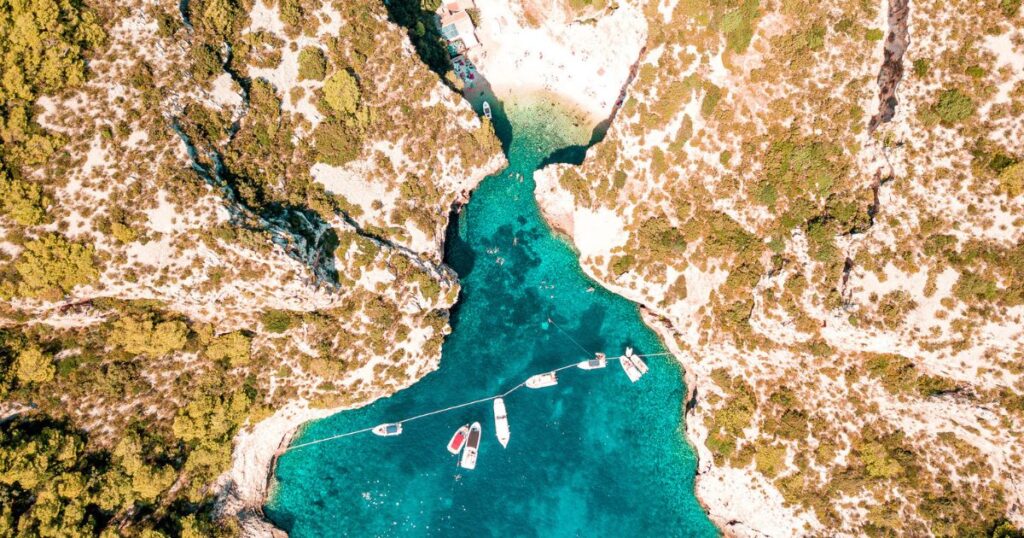
Most beautiful beaches are open to the sea. Stiniva is the opposite. It is a near enclosed cove on the southern coast of Vis island, ringed by cliffs that rise sharply on both sides, with only a narrow mouth connecting it to the open Adriatic. That opening is just a few metres wide, which is why the bay feels hidden until you are almost inside it.
The beach itself is smooth white pebble, and the water deepens quickly from a pale shallow rim to a richer blue in the centre. Because the cliffs shelter the cove from wind, the surface is often glassy when the sea outside is choppy. The whole place has the feel of a natural amphitheatre that happens to be filled with seawater.
How the cove was formed
Stiniva’s shape is not an accident of pretty coastline. It is the remains of a collapsed sea cave.
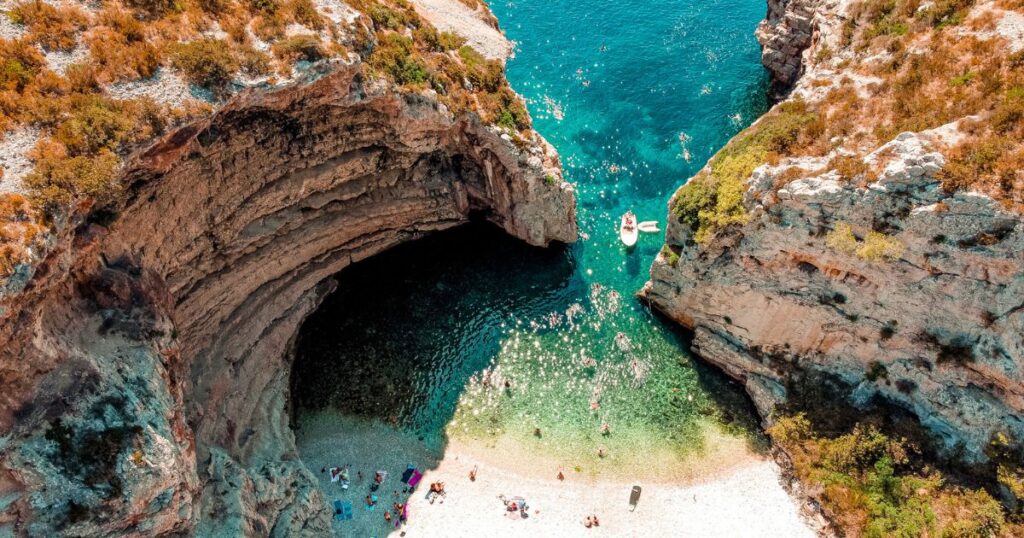
Long before it was a beach, this was almost certainly a large cave carved into the limestone by the sea, the same slow process that shapes caves all along this coast. Over time the roof of that cave weakened and fell in, leaving the open bowl you see today. The narrow rock arch at the entrance is what survived of the original cave mouth, a stone gateway that never collapsed.
That geological story links Stiniva to the other headline sight in these waters. If you have read our guide on why the Blue Cave glows blue, you already know how powerfully the sea works limestone in this region. Stiniva is what happens when a cave like that loses its ceiling, and the Blue Cave is one that kept it. Seen side by side, they tell two halves of the same natural process.
Stiniva is protected as a geomorphological monument in Croatia, which recognises both its rarity and its fragility.
The two ways to reach Stiniva
There are exactly two ways into the cove, and they suit very different kinds of traveller.
By sea
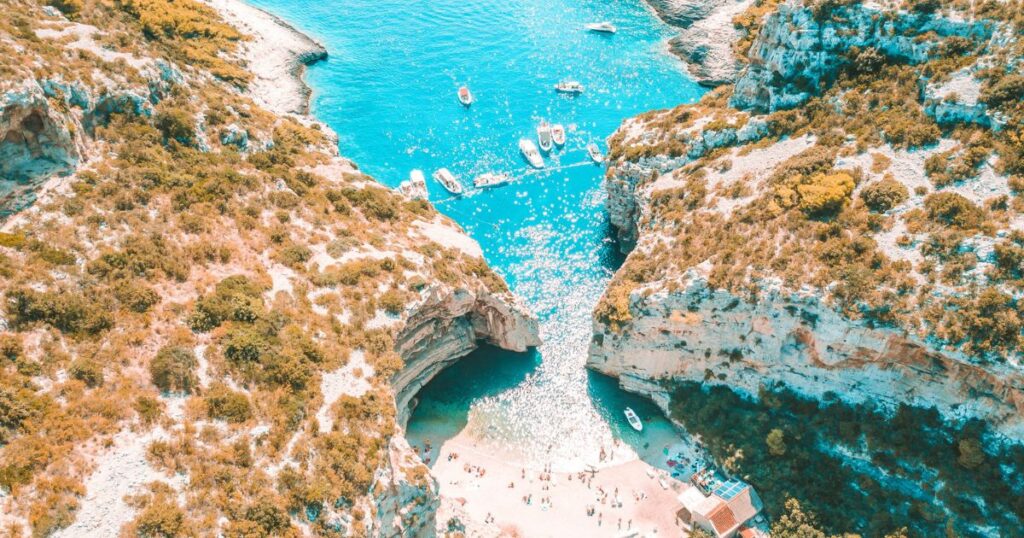
The easy route is from the water. Boats cannot beach inside the cove, so they anchor just outside the narrow entrance, and visitors swim or wade through the gap to reach the pebbles. The approach is the best part. You watch the cliff wall part in front of you and the hidden bay reveal itself, which is an arrival no land route can match.
This is also why Stiniva appears on so many island itineraries from the mainland. It pairs naturally with the wider sweep of sights around Vis and Biševo, and it is one of the regular stops on a full day at sea, including our Blue Cave Croatia tour, which reaches the cove as part of the same loop that takes in the cave and the old town of Komiža.
On foot
The land route is for those who want to earn the view. A footpath leads down from the road above the cove, and it is steep, rocky and exposed to the sun, with a descent that takes most people around twenty to thirty minutes. The climb back up is harder and slower, so it suits walkers in decent shape with proper shoes and plenty of water. The reward is the cove from above first, a striking aerial angle, before you drop into it.
If you are not confident on uneven ground, the sea route is by far the gentler choice.
When to go for the calmest visit
Stiniva’s fame is also its main challenge. In July and August the cove fills up by late morning, and on the busiest days the small beach can feel crowded once several boats have arrived together.
The trick is timing. Early morning and later afternoon are noticeably quieter, before and after the midday wave of day boats. June, September and early October spread the visitors more thinly across the day while the sea stays warm enough for a long swim. The water inside the cove is sheltered, so even on a breezier day Stiniva often stays swimmable when more open beaches do not.
One thing worth knowing is that strong southerly wind pushes swell straight into the narrow entrance, which can make swimming through the gap uncomfortable. On those days a flexible plan helps, since conditions can change the order of stops on any trip around Vis.
What to bring and what to expect
A few small things make the visit smoother.
Wear or pack water shoes. The beach is pebble rather than sand, and the entry over stones is easier on bare feet with a thin sole.
Bring water and sun protection. The cliffs give shade only at the edges for part of the day, and the centre of the cove sits in full sun. Facilities are very limited, so do not rely on finding much beyond a small seasonal spot for a drink.
Pack light and dry. If you arrive by boat you will be swimming in, so a dry bag for a phone and a towel is worth having.
Respect the protected status. Take everything out that you bring in, avoid disturbing the loose rock on the slopes, and remember the cove stays beautiful only because visitors treat it gently.
Where Stiniva fits in a day on the water
On its own Stiniva is a single, perfect swim stop. Within a full day at sea it becomes part of a bigger story, the collapsed cave next to the glowing one, the sheltered cove between the open crossings, the quiet pause between the busier highlights around Vis and Biševo. That contrast is what makes the route memorable rather than just scenic.
If you would rather have the timing, the anchoring and the crossings handled, joining a guided day that already includes Stiniva is the simplest way to see it without the steep descent or the logistics. Whichever way you arrive, aim for the quieter hours, watch the cliff wall open in front of you, and give yourself time to float in the most hidden swim in the Adriatic.
Whether you want to discover hidden coves or iconic islands, exploring the Adriatic through our Split boat tours guarantees an unforgettable summer experience.